
Pruning
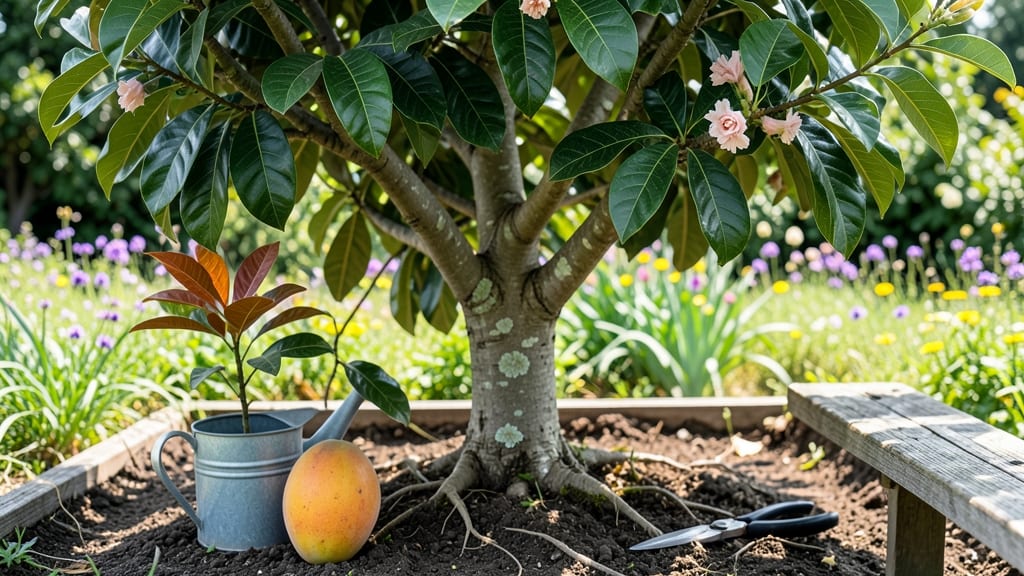
Identifying a mango tree starts with its leaves—long, glossy, and shaped like an oval with a pointed tip, almost like a hand with fingers spread just a little too wide. 🌿 I’ve spent years spotting these trees in tropical groves and urban backyards, and the leaves are always the first giveaway, even before the fruit appears.
The bark is another dead giveaway: rough and dark when mature, but smooth and greenish when young, almost like a tree that’s still figuring out its adult skin.
Mango flowers are tiny and fragrant, clustered in dense bunches that look like nature’s version of a chandelier. The fruit itself is the showstopper—round or oval, with skin that can range from green to vibrant red, orange, or yellow when ripe.
Young trees might not have fruit yet, but their leaves and growth habit (fast-growing with a broad canopy) will still point you in the right direction.
Confusing it with other trees? Look for the distinctive leaf veins that run parallel like train tracks, and the smooth, leathery texture of the leaves—nothing else in the tropical lineup quite matches that combo.
Saplings have smaller versions of these features, so keep an eye out for those telltale ovals even when the tree is still knee-high.
Once you’ve got the basics down, you’ll spot mango trees everywhere—even in unexpected places like city streets or neighbor’s yards. The key is training your eye to notice the leaf shape first, then confirm with the bark, flowers, or fruit.
No need for fancy tools; just a sharp eye and a little patience.
📚 In This Guide
- What you need
- Instructions
- Tips and common mistakes
- Wrapping up and next steps
What you need
- ● Hand lens or magnifying glass (1–2x magnification) – Helps examine fine details like leaf veins, bark texture, and fruit surface.
- ● Measuring tape or ruler (6–12 inches) – For measuring leaf length, width, and fruit dimensions.
- ● Notebook and pen – To record observations like leaf shape, color, and fruit characteristics.
- ● Camera (smartphone or digital) – Capture high-resolution images of leaves, bark, flowers, and fruit for comparison.
- ● Pruning shears or small knife – For safely collecting a few leaves or small samples (if needed for closer inspection).
- ○ Gloves (optional but recommended) – Protects hands from thorns or rough bark, especially in wild or untamed areas.
- ● Field guide or mango tree identification app (e.g., PictureThis or PlantNet) – Cross-reference your findings with expert databases.
- ● Small sample bags – Store leaf or fruit samples for later analysis if you’re unsure.
- ● Sunlight or flashlight – Ensures you can see details clearly, especially in shaded areas.
- ● Local gardening or agricultural expert – A quick consult can save time if you’re in a region with multiple mango varieties.
Step-by-step guide to recognizing mango trees
Here's how I spot a mango tree—no fruit needed, just a few key details.
🌿 Step 1: Examine the Leaves for Classic Shape
Mango tree leaves are long, oval, and glossy with a pointed tip, typically 6-12 inches long and 2-4 inches wide. They grow in a spiral pattern along the branches, alternating sides. The edges are smooth, not serrated, and the surface feels slightly leathery when touched. Young leaves start out reddish-purple before turning deep green.
Here's the thing—mango leaves have visible veins that run parallel along the length, with smaller veins branching out at slight angles. If you see leaves like this, you're on the right track. I always check the underside too; it should be a lighter green with a faint velvety texture.
🌱 Step 2: Look for Distinctive Bark and Branch Patterns
The bark of a mature mango tree is grayish-brown and scaly, with a rough texture that develops deep furrows as the tree ages. Young branches have a smooth, greenish-gray bark that eventually cracks into small plates. The way these plates overlap gives the tree its signature rugged look.
Pay attention to the branch arrangement too. Mango trees have a spreading, rounded canopy with branches that grow outward rather than straight up. The angle between branches and the trunk is usually wider than 45 degrees, creating that classic tropical silhouette. If you see a tree with this open structure, it's a strong candidate.
🌶️ Step 3: Check for Flower Clusters and Fruit Development
Even without fruit, mango trees produce distinctive panicles of small, fragrant flowers that appear in clusters at the ends of branches. These flowers are yellowish-white with red or pink tints and have a sweet, tropical scent that's unmistakable. If you spot these flower clusters, you've likely found a mango tree.
When fruit is present, look for the oval shape with a single large seed inside. Mature mangoes have a smooth, slightly fibrous skin that can range from green to red, yellow, or even purple when ripe. The fruit grows directly from the trunk or main branches, not just the ends of smaller limbs. This growth pattern is unique to mango trees.
⏰ Step 4: Consider Seasonal Clues and Location
Mango trees thrive in tropical and subtropical climates and are rarely found in temperate zones without protection. They're commonly grown in Florida, California, Hawaii, and other warm regions of the U.S. If you're identifying a tree in one of these areas, your chances are much higher.
Timing matters too. Mango trees typically flower in spring and produce fruit 6-8 months later, depending on the variety. If you see a tree with both flowers and developing fruit in late summer or fall, it's almost certainly a mango. I've found that even small trees with just a few leaves can be identified this way if you know what to look for.
Tips & tricks for identifying mango trees
Real talk: Even experienced gardeners sometimes mix up mango trees with other tropical species. Here's how I've learned to spot them without a single doubt.
Leaf Texture Test: The underside of mango leaves is your secret weapon. Run your fingers along the bottom—it should feel slightly fuzzy or velvety, not smooth like avocado or citrus leaves. I've used this trick to confirm mango trees in nurseries where they were labeled incorrectly. The leathery feel is unmistakable once you know what to look for.
Branch Angle Rule: Pay attention to how branches grow from the trunk. Mango trees have a distinctive wide-angle branching (over 45 degrees) that creates that classic rounded shape. I've seen people mistake citrus trees for mangoes because they both have glossy leaves, but citrus branches grow more upright. This angle difference is the giveaway.
Seasonal Clues: If you're examining a tree in late summer or fall and notice both flower clusters AND developing fruit, that's your confirmation. Mango trees have a unique overlapping bloom cycle where flowers appear in spring but can persist alongside fruit. This dual presence in late summer is rare among other tropical trees.
Pro Tips for Identify Mango Tree
- Real talk: Even experienced gardeners sometimes mix up mango trees with other tropical species.
- Leaf Texture Test: The underside of mango leaves is your secret weapon.
- Branch Angle Rule: Pay attention to how branches grow from the trunk.
Frequently asked questions
Got questions about spotting a mango tree? Here are some common ones—and their answers—to help you stay on track!
How can I tell if a young tree is a mango tree before it bears fruit?
A young mango tree can be identified by its compound leaves (3-9 leaflets per branch) and distinctive reddish-brown bark. Look for oval-shaped leaflets with serrated edges and a smooth, glossy texture. If the tree has these features, it’s likely a mango—even if no fruit is visible yet!
When is the best time of year to identify a mango tree by its leaves?
The ideal time to inspect a mango tree’s leaves is during the dry season (late fall to early spring), when the tree is fully leafed out. Avoid rainy seasons, as excess moisture can make leaves appear darker or distorted. Morning sunlight is best—it highlights leaf structure clearly.
What if the tree has leaves that look like mango but no fruit? Could it still be a mango?
Yes! Some mango varieties, like ‘Keitt’ or ‘Kent’, take 3-5 years to bear fruit. If the leaves match (compound, glossy, serrated) and the bark is rough and scaly, it’s likely a mango. Check for small flower buds in spring—these confirm it’s a fruit-bearing tree.
Are there other trees that look similar to mango trees?
Yes! Cashew, pistachio, and sapodilla trees can resemble mangoes at first glance. Key differences:
- Cashew: Leaves are shinier with smooth edges; no serrations.
- Pistachio: Leaves are smaller (1-3 leaflets) and silvery-green.
- Sapodilla: Leaves are thicker and leathery with a dull finish.
What should I do if I think a tree is a mango but it’s not producing fruit?
If the tree matches mango traits but isn’t fruiting, it could be:
- Too young (3+ years for most varieties).
- Male (non-fruiting) or pollination-deficient.
- Stressed by poor soil, pests, or disease.
Wrapping up and next steps
Identifying a mango tree is easier than you think—just look for those distinctive leaves (long, glossy, and oval-shaped) and fruit clues (sweet aroma, rough skin, and that iconic shape). Whether you’re a gardener, traveler, or fruit enthusiast, spotting one now becomes a fun adventure! 🌿🍈
Ready to take the next step? Plant one yourself or share your newfound knowledge with fellow plant lovers. Your mango-spotting skills just leveled up—now go enjoy (or grow) the tropical treasure! 🌱✨