Pruning
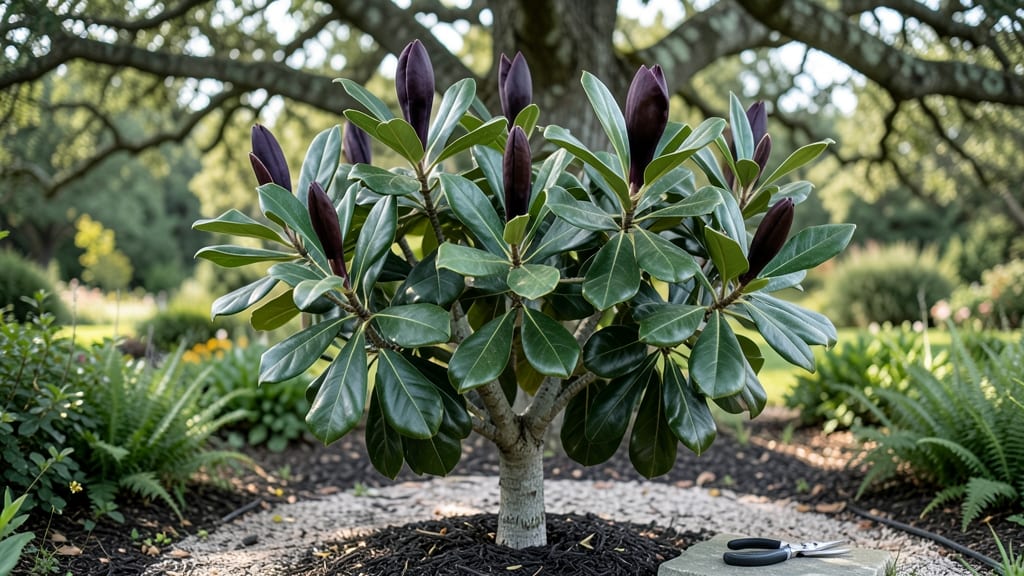
The black tulip magnolia tree thrives when pruned just right in late winter—especially in the Pacific Northwest’s chilly climate. ✂️ I’ve learned the hard way that timing matters: cut too early, and frost will damage fresh cuts; wait too long, and you’ll prune away next year’s blooms.
The key is a crisp morning in February or March, when the tree’s dormant but the weather cooperates.
You’ll need sharp pruning shears, rubbing alcohol for sterilizing cuts, and a clear day to see the branches. The goal is to open the center for airflow and shape the tree while preserving its signature dark purple-black blooms.
My first pruning attempt left the tree looking like a tangled mess—until I realized the magic is in the thinning, not just trimming. Focus on removing crossing branches and dead wood first, then lightly shape the outer canopy.
After pruning, you’ll notice something remarkable: the tree’s dramatic, tulip-shaped flowers appear even more striking against its glossy evergreen leaves. The blooms darken as they age, creating that coveted black-tulip effect.
Plus, the better the airflow, the fewer fungal issues you’ll face come summer. By late spring, your magnolia will reward you with clusters of blooms that last for weeks.
This method works for both young trees and mature specimens, though older trees may need gradual shaping over a few years. The Pacific Northwest’s damp climate means you’ll want to avoid heavy pruning in fall, when fungal spores are most active.
With the right cuts, your black tulip magnolia will become the showstopper of your garden—year after year.
📚 In This Guide
- What you need
- Instructions
- Tips and common mistakes
- Wrapping up and next steps
What you need
- ● Pruning shears: Bypass pruners (sharp, 6–8" blades) for small branches (¼"–1" thick). Pro tip: Clean blades with rubbing alcohol to prevent disease spread! 🔪
- ● Loppers: 1 pair (18–24" handles) for branches 1–3" in diameter.
- ○ Pruning saw: Curved-tooth saw for thick branches (3"+). Optional: A folding handsaw for larger limbs if your magnolia is mature.
- ● Disposable gloves: Heavy-duty work gloves (nitrile-coated) to protect from thorns and sap.
- ● Pruning sealant: 1 small bottle (e.g., Tanglefoot Tree Wound Pruning Sealer) for cuts larger than ½". Note: Only use on healthy wood—avoid diseased or dead branches.
- ● Disinfectant: 70% isopropyl alcohol or a pruner sanitizer (e.g., Everris Pruning Spray) to sterilize tools between cuts.
- ● Ladder: Extendable aluminum ladder (20–24 ft) if the tree exceeds 10 ft tall. Safety first: Use stabilizers and a spotter!
- ● Heavy-duty trash bags: 2–3 (13-gallon) for collecting debris.
- ● Permanent marker: Fine-tip for labeling branches (if removing large sections).
- ● Extension pole pruners: For high branches without a ladder (e.g., Fiskars 10" Extendable Pruner).
- ● Magnifying glass: For inspecting buds and identifying dormant flower clusters (critical for Black Tulip Magnolias!).
- ● Tree tie or zip ties: To secure scaffold branches if you’re doing structural pruning.
- ● Camera: Snap photos of the tree’s shape before/after for reference.
- ● Hot cocoa or thermos: Because PNW winters deserve a reward after a job well done! ☕
- ● Timing: Prune on a dry, frost-free day between late winter (Feb–March) and early spring before buds swell. Avoid pruning after the first bloom.
- ● Weather check: Confirm no rain or wind is forecasted for 24 hours post-pruning.
- ● Tree health: Inspect for anthracnose fungus or powdery mildew—prune out infected branches last and sterilize tools thoroughly.
- ● Safety gear: Closed-toe shoes, long sleeves, and eye protection (sap can irritate!).
Step-by-Step instructions for pruning black tulip magnolias in late winter
Here's how I shape mine for strong Pacific Northwest blooms—timing and technique matter most.
✂️ Step 1: Time Your Cuts for Dormancy
Prune your black tulip magnolia 6-8 weeks before bloom time, typically in late February or early March when the tree is fully dormant. Look for bare branches with no buds—this is your signal. I avoid cutting after mid-March in the PNW, as new growth can't harden off before spring frosts.
Use a sharp pair of bypass pruners to make clean cuts at a 45-degree angle, about ¼ inch above an outward-facing bud. This encourages growth in the right direction. If you see any dead or crossing branches, remove them first—they compete with healthy growth and invite disease.
🌿 Step 2: Remove Weak and Crowded Growth
Start by thinning out 10-20% of the weakest stems—these are the ones with thin, spindly growth or no flower buds. I focus on branches growing inward or rubbing against others, as these will never develop properly. Remove them entirely at the base, cutting just outside the branch collar where it meets the trunk.
Next, look for water sprouts—those fast-growing, vertical shoots that pop up everywhere. These steal energy from your blooms. Snip them off at the base without hesitation. The goal here is to open up the canopy so air circulates and sunlight reaches the center of the tree.
☀️ Step 3: Shape for Light and Airflow
Step back and assess the tree's overall shape. Your black tulip magnolia should have a balanced, open structure that lets light filter through to the center. Start by shortening overlong branches by ⅓ of their length, cutting just above a bud that faces outward. This prevents a "lion's tail" effect where branches all grow in the same direction.
Pay special attention to the lower third of the tree. If branches are too dense here, they'll block sunlight from reaching the ground, where you might want to plant companion shrubs. Thin out the thickest branches first, then work your way up. Remember: less is more—you can always prune more later, but you can't un-cut a branch.
💧 Step 4: Clean Up and Protect Wounds
After making your cuts, wipe your pruners with rubbing alcohol to prevent spreading disease between branches. Now's the time to sterilize any tools you've used—this is especially important in the damp PNW climate, where fungal spores thrive. I like to keep a small bottle of 70% isopropyl alcohol in my pruning kit for quick cleanups.
For larger cuts over ½ inch in diameter, apply a pruning sealant to protect the wound. This isn't necessary for small cuts, but it helps prevent moisture loss and disease entry on bigger pruning wounds. Water the base of the tree thoroughly after pruning to help it recover—aim for 1-2 gallons spread evenly around the root zone.
Tips & tricks for pruning black tulip magnolias
Pruning magnolias can feel intimidating, but these key strategies will help you shape your tree with confidence.
Timing is Everything: The 6-8 week window before bloom is non-negotiable for black tulip magnolias. I've learned the hard way that cutting too early can stimulate premature growth, while waiting too long risks spring frost damage. In the PNW, mark your calendar for late February—this gives your tree time to harden off before our famous March frosts. If you miss this window, wait until after blooming, but expect smaller flowers next year.
The 45-Degree Angle Secret: When making cuts in Step 1, that 45-degree angle isn't just for looks—it helps water run off the wound and prevents rot. I use a small protractor tool attached to my pruners to ensure consistency. For larger branches, make the cut just outside the branch collar where it meets the trunk. This little detail makes all the difference in how quickly the tree heals.
Visual Pruning Cues: In Step 3, when shaping your tree, look for branches that form a "V" shape when viewed from above—these are your keepers. The ones growing straight up or inward are the ones to remove. I like to step back every 5 minutes and squint—this helps me see the overall shape more clearly. Remember, you're aiming for that open vase shape that lets sunlight reach all parts of the tree.
PNW-Specific Protection: Our damp climate means extra attention to wound care. After pruning, I always carry a small bottle of 70% isopropyl alcohol to sterilize my tools between cuts. For larger wounds over ½ inch, that pruning sealant isn't just optional—it's essential in our rainy season. Think of it like putting a bandage on a cut: it helps prevent disease from taking hold in those vulnerable spots.
Pro Tips for Black Tulip Magnolia Tree
- Pruning magnolias can feel intimidating, but these key strategies will help you shape your tree with confidence.
- Timing is Everything: The 6-8 week window before bloom is non-negotiable for black tulip magnolias. I've learned the ...
- The 45-Degree Angle Secret: When making cuts in Step 1, that 45-degree angle isn't just for looks—it helps water run ...
Frequently asked questions
about pruning your Black Tulip Magnolia in the Pacific Northwest—because even pros have questions! Here are the most common ones to help you prune with confidence.When is the exact best time to prune my Black Tulip Magnolia?
The absolute sweet spot is late winter (February–early March) after the worst frost has passed but before buds swell. In the PNW, aim for after the risk of hard freezes (below 15°F)—typically mid-February. Pruning too early risks cold damage, while waiting too long may stress the tree before spring growth.
What if I missed the late-winter window? Can I still prune now?
You can prune lightly in early spring (March–April) if you missed late winter, but avoid heavy cuts. Wait until after flowering (May–June) for minimal impact. Never prune in fall—it invites disease and weakens frost hardiness. If you’re late, focus on removing only dead or crossing branches.
How much can I trim without harming my Black Tulip Magnolia?
Stick to the 10–20% rule: Never remove more than 20% of the canopy in one year. For mature trees, limit cuts to thinning (selective branches) rather than topping (shearing). Over-pruning stresses the tree and reduces next year’s stunning purple-black blooms. If unsure, start with 1–2 main branches and observe growth.
Why are my leaves yellowing/browning after pruning?
Yellowing or browning can signal stress from over-pruning, disease, or pests. Check for:
- Fungal issues (like powdery mildew)—prune in dry weather and sterilize tools.
- Spider mites/scale (common in PNW summers)—spray with neem oil if webs or sticky residue appear.
- Environmental shock—if leaves drop post-prune, ensure the tree’s roots are well-watered (but not soggy) for 2–3 weeks.
If symptoms persist, consult a local arborist.
Are there alternatives to pruning if my tree looks messy?
If pruning feels overwhelming, try these low-effort fixes:
- Thin out dense foliage with hand pruners (no saw needed) to improve airflow.
- Remove only water sprouts (fast-growing, vertical shoots)—these drain energy.
- Mulch properly (3–4" of wood chips) to reduce stress and encourage healthy growth.
- Fertilize lightly with acid-loving plant food (like azalea/camellia mix) in early spring.
For severe cases, hire a certified arborist—they’ll know how to preserve those iconic blooms while keeping your tree thriving.
Wrapping up and next steps
The Black Tulip Magnolia is a stunning Pacific Northwest gem, and with the right late-winter pruning, you’ll help it thrive through frost and flourish for years to come! 🌿 By following these steps—cleaning tools, shaping strategically, and protecting vulnerable branches—you’ll ensure a healthy, vibrant tree that rewards you with bold blooms.
Now that you’re armed with the know-how, grab your pruners and get to work—your magnolia will thank you with a canopy of deep purple beauty!
Next step: Mark your calendar for late February to early March (just before buds swell) and treat your tree to a little TLC. Happy pruning! ✂️